
















The Hawker Siddeley Trident Tragedy: The Advanced British Innovation ‘Killed’ by Customer Demands

The aviation world knows the Hawker Siddeley Trident (DH121) as a technological pioneer. However, history records it as a bitter reminder of how flawed market research and client intervention can destroy a masterpiece’s potential. This is the story of the world’s first trijet, which suffered a crushing defeat at the hands of the Boeing 727.
The Dilemma: Turboprops vs. The Jet Age
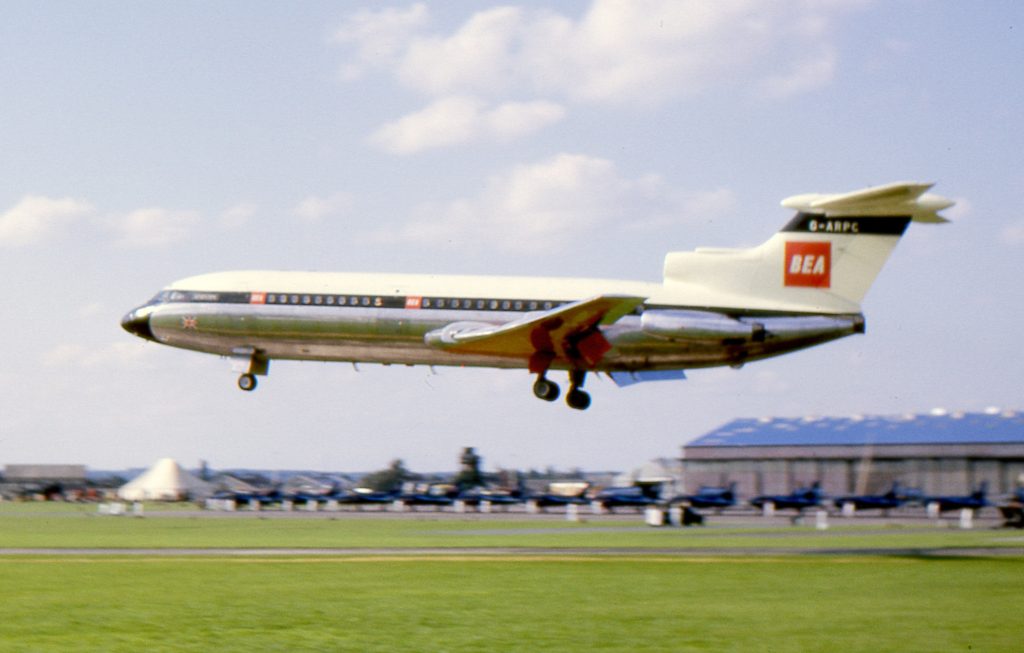
In the early 1950s, British European Airways (BEA) was at the height of its success thanks to the Vickers Viscount. As the world began shifting toward pure jet engines—led by aircraft like the Sud Aviation Caravelle—BEA’s management remained skeptical about the economic viability of jet engines.
It wasn’t until late 1956 that BEA leadership realized they needed a short-haul jet to remain competitive. They released a set of specifications, which De Havilland answered with the DH121 design.
DH121 Innovation: The Trijet Pioneer
The DH121 was designed to be an extraordinary aircraft. Featuring three rear-mounted engines (a trijet configuration), it offered a perfect balance between fuel efficiency and takeoff safety. Some of its revolutionary features included:
- Autoland System: The first civilian aircraft capable of fully automatic landings in zero-visibility conditions.
- Triple Redundancy: Three independent hydraulic systems for maximum safety.
- High Speed: Capable of cruising at Mach 0.88, making it one of the fastest airliners of its era.
Strategic Blunder: Downsizing Potential for a Single Client
The Trident’s commercial tragedy began when BEA asked De Havilland to shrink the aircraft’s size due to a brief recession. Although market research showed that global airlines wanted a larger plane, De Havilland was forced to comply with BEA’s demands.
The result? Passenger capacity was slashed from 111 to just 75–80, and the powerful Medway engines were replaced with smaller Rolls-Royce Spey units. Meanwhile, Boeing launched the 727 with specifications nearly identical to the original DH121 design that BEA had rejected.
The sales figures were worlds apart: the Boeing 727 sold over 1,800 units, while the Trident sold only 117.
An Unforgettable Legacy
Despite its commercial failure, the Trident was a “pilot’s airplane.” It was known for being incredibly responsive and “honest” in the air. Its wing technology even served as the structural foundation for the future Airbus A300.
The Trident officially retired from British Airways in 1985, but its contribution in pioneering automatic landings is still felt by millions of modern airline passengers today.